
AI forecasting applies machine-learning systems to historical and contextual signals to estimate future numeric outcomes. A decision-ready workflow also needs scenarios, validation and evidence for the assumptions behind a forecast.
Forecasts are distributions, not promises
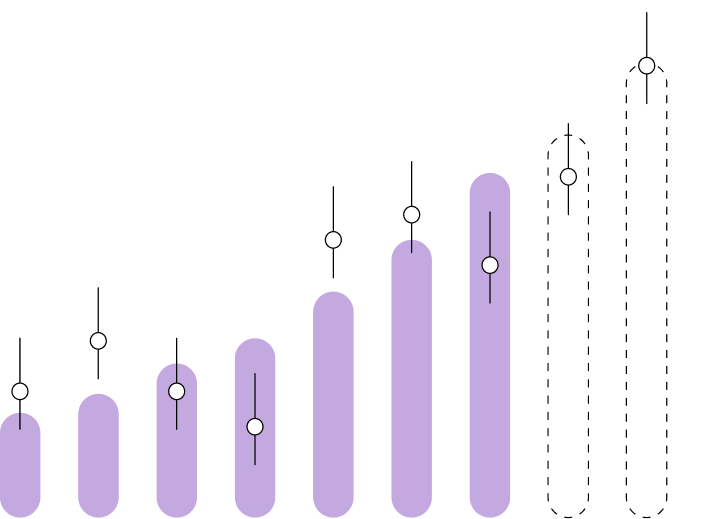
A single-point estimate hides the range of plausible outcomes. Probabilistic paths such as p10, p50 and p90 make that range visible and give decision makers a clearer basis for comparing risk.
Scenarios make assumptions testable
Base, upside, downside and stress cases let teams change assumptions and inspect their effects. The objective is not guaranteed accuracy. It is a disciplined comparison of possible outcomes under stated conditions.
Good forecasting does not remove uncertainty. It makes uncertainty usable.
Validation belongs in the product
Backtesting compares model behavior with historical outcomes. Baselines and reference models provide necessary context: a complex model is only useful when its results can be evaluated against simpler alternatives.
Evidence provides decision context
Numbers do not explain every business change. Connecting forecasts to source-backed facts, entities and relationships helps teams inspect the context around a scenario without presenting causal explanations that the data cannot support.
From model output to decision workflow
The model is one component. Data contracts, feature pipelines, validation, scenario controls, evidence and reporting determine whether the forecast can support an actual decision.